

Skip to content
Products · Engineering · Intelligence

Building Intelligent Systems That Move Your Business Forward.

We design and develop custom software, AI/ML, computer vision, automation, and cloud solutions that turn complex problems into measurable business growth.

02 — WHAT WE DO

What we build.

A technology project can take several different forms. These are the shapes it usually takes, and what each one actually involves.

Capability — not a record of completed customer deployments
01

Technology Products

Devices and product systems engineered end to end — hardware, firmware, software and the services around them, built as one product rather than assembled from parts.

  • Embedded systems
  • Firmware
  • Product interfaces
  • Connected services

Fits when: A physical product that needs its hardware, software and cloud layer designed together.

02

Custom Software

Applications and backend systems built around a specific operational process, rather than configured from a generic platform.

  • Web applications
  • APIs
  • Databases
  • Systems integration

Fits when: An internal tool or client-facing platform that has to fit how the business actually works.

03

Intelligent Systems

Software that includes a model or a decision step — where a rule-based system is not enough and the output has to be learned or inferred.

  • Machine learning
  • Decision logic
  • Model evaluation
  • Data pipelines

Fits when: A workflow that currently depends on a person making a judgement call from data.

04

Connected Devices

Hardware that reports telemetry, receives commands, or coordinates with other devices through a network and a cloud service.

  • IoT platforms
  • Edge computing
  • Device connectivity
  • Telemetry

Fits when: Equipment that needs to be monitored, controlled or coordinated remotely.

05

AI & Computer Vision

Systems that interpret images, video or sensor data — detection, tracking, classification and the pipeline that turns that into a usable signal.

  • Computer vision
  • Video intelligence
  • Model development
  • Real-time inference

Fits when: A process that currently relies on someone watching a camera feed or inspecting output by eye.

06

Data & Automation

Pipelines that move and structure operational data, and the automated workflows that act on it without a person triggering each step.

  • Data ingestion
  • Analytics
  • Workflow automation
  • Event-driven systems

Fits when: Repetitive manual steps between systems that don't yet talk to each other.

03 — PHILOSOPHY

Technology should solve real problems — not perform complexity.

We start from the constraint, not the stack. What gets built is whatever actually resolves the problem: a device, a model, a platform, or the quiet integration between them.

We connect

Ideas
Engineering
Intelligence
Products
People
04 — PRODUCTS

Technology products, engineered end to end.

Turning a technical concept into a working product means hardware, firmware, software and the services around it have to be designed as one system.

01

Product Engineering

From an early technical concept to a working product — bringing hardware, firmware, software and connected services together into a single engineered system.

02

Hardware Products

Physical devices designed around a function: enclosure, component selection and the constraints of manufacturing and power, not just a circuit that works on a bench.

03

Embedded Systems

Firmware and low-level software running directly on device hardware, where timing, memory and power budgets are part of the design, not an afterthought.

04

Device Software

The software layer that turns hardware into a usable product — local interfaces, on-device logic and the bridge to whatever it connects to.

05

Connected Devices

Devices that report state, accept commands or coordinate with each other, built with the network and security model considered from the start.

06

IoT Platforms

The cloud-side service a fleet of devices reports into — ingestion, device management and the interfaces that make a fleet operable.

07

Product Interfaces

The screens, apps and control surfaces a product is actually operated through, designed for the device's real constraints rather than a generic UI kit.

08

Product Integration

Fitting a new product into what already exists — other equipment, existing software, or an operational process it has to slot into.

05 — SOLUTIONS

Technology engineered around a specific operation.

A solution is built for how a business actually runs — its data, its constraints, and the systems it already depends on — rather than adapted from a generic platform.

01

Custom Software

Built around a specific process rather than adapted from a generic platform — the data model and workflow match how the operation actually runs.

02

Enterprise Applications

Internal systems used by an organisation to run an operation — access control, reporting and the workflows specific to that business, not a one-size template.

03

Backend Systems

The services underneath an application: business logic, data storage and the boundaries between what different systems are responsible for.

04

API Engineering

Interfaces designed for the systems that will actually call them — versioned, documented and built to be a stable contract, not just an endpoint that works today.

05

Systems Integration

Connecting software that was never designed to talk to each other — reconciling data formats, authentication and timing between separate systems.

06

Cloud Engineering

Infrastructure sized and configured for what a system actually needs — deployment, scaling and the operational visibility to know it's working.

07

Workflow Automation

Replacing a manual, repeated sequence of steps between systems with a process that runs itself and reports when it can't.

08

Monitoring Platforms

Dashboards and alerting built around the metrics that actually matter for an operation, not a generic analytics package.

09

Data Platforms

The infrastructure that collects, stores and structures data from multiple sources so it can actually be queried and used.

06 — AI & INTELLIGENCE

Intelligence, applied where it changes the outcome.

An intelligent system is a chain: perceive, interpret, decide, act. We build the whole chain — and the parts of it that have to be right.

01

See

Capture signal from cameras, sensors and systems.

Data → Processing

02

Understand

Turn raw input into structured, reliable meaning.

Model → Evaluation

03

Reason

Apply models and rules to reach a decision.

Decision

04

Act

Trigger the response in the system that matters.

Action

Capability areasArtificial IntelligenceMachine LearningComputer VisionVideo IntelligenceData IntelligenceIntelligent AutomationDecision SupportModel DevelopmentModel Evaluation
07 — COMPUTER VISION

Interpreting what a camera sees.

Turning images and video into structured, usable information — the specific techniques involved, not a single black-box capability.

01

Detection

Locating objects, defects or events of interest within an image or frame.

02

Tracking

Following a detected object's position and movement across a video sequence.

03

Classification

Assigning a category to what has been detected — what it is, not just where it is.

04

Image Analysis

Extracting structured information from a single still image.

05

Video Analysis

Interpreting patterns and events across a continuous video stream over time.

06

Visual Inspection

Comparing what a camera sees against an expected reference to flag deviation.

07

Object Recognition

Identifying specific known objects within a scene, not just generic categories.

08

Real-time Video Intelligence

Running detection and analysis on a live feed within the time a decision requires.

08 — HARDWARE + IoT

From a device to a fleet.

A single sensor and a connected fleet of thousands raise the same underlying questions: what runs on the device, what runs at the edge, and what the cloud needs to see.

1

Device

The physical hardware collecting or acting on data.

2

Edge

Local processing on or near the device, before transmission.

3

Network

The connection carrying data between device and cloud.

4

Cloud

Infrastructure that receives, stores and manages device data.

5

Data

Structured records built from what devices report.

6

Intelligence

Models and logic applied to that data to produce a decision.

01

Hardware

Physical components and boards selected and integrated for a specific function.

02

Embedded Systems

Software that runs directly on device hardware under real timing and power constraints.

03

Firmware

The low-level code that controls a device's hardware directly.

04

Sensors

The components that turn a physical quantity into data a system can act on.

05

Device Connectivity

The networking layer that lets a device report and receive commands reliably.

06

Edge Computing

Processing data on or near the device itself, before it ever reaches the cloud.

07

Telemetry

The stream of operational data a device reports back about its own state.

08

IoT Platforms

The service layer a fleet of devices reports into and is managed through.

09

Cloud-to-Device Integration

The link that lets cloud systems send commands and configuration back down to a device.

09 — SOFTWARE + CLOUD

The layer that connects everything else.

Software is what makes a product usable and a solution operable — and what lets it talk to devices, models and other systems.

1

Interface

What a person or operator directly sees and uses.

2

Application

The logic that runs behind that interface.

3

API

The contract the application uses to reach other systems.

4

Data

Where the application's information is structured and held.

5

Cloud

The infrastructure the whole system is deployed and run on.

6

Connected Systems

Devices, AI systems or other software the platform links to.

01

Web Applications

The interface layer a user or operator actually interacts with.

02

Backend Systems

The services handling business logic behind an application.

03

APIs

The contracts that let separate systems and services call each other reliably.

04

Databases

Where operational data is structured and stored for actual use.

05

Cloud Infrastructure

The compute, storage and networking a system runs on.

06

Deployment

The process that moves code from built to running in production safely.

07

Monitoring

Visibility into whether a running system is actually behaving as expected.

08

Integration

Connecting a software system to whatever else it needs to exchange data with.

10 — DATA + AUTOMATION

Knowing, and then acting on it.

Data and automation solve different problems, and are often confused for one another.

KNOWING

Data

Data is about knowing — turning raw signal into structured information that can be queried, analysed and trusted.

ACTING

Automation

Automation is about acting — using that information (or a trigger) to run a process without a person doing each step manually.

The two connect: automation that acts on bad data just fails faster. Data work usually comes first; automation is what makes it operationally useful.

01

Data Ingestion

Bringing data in from devices, applications or external sources into one place.

02

Data Processing

Cleaning, transforming and structuring raw data into a usable form.

03

Data Modelling

Structuring data so it reflects the real relationships in the operation it describes.

04

Analytics

Turning structured data into a measurable answer to an operational question.

05

Operational Dashboards

Surfacing the specific metrics an operation needs to see, continuously.

06

Workflow Automation

Replacing a manual sequence of steps with a process that runs on its own.

07

System-to-System Automation

Letting separate systems trigger actions in each other without manual handoff.

08

Event-Driven Workflows

Automation that reacts the moment a relevant event happens, rather than on a schedule.

11 — TECHNOLOGY ECOSYSTEM

A connected technology ecosystem.

Depth in each area, and the integration work that makes them function as one system. Hover or focus a node to see how it connects.

12 — HOW WE BUILD

Have a technology challenge?We can build it.

Bring the problem rather than the specification. This is the engineering approach used for a project once we take it on — not a fixed company history, a working sequence.

  1. 01

    Discover

    Understand the problem, users, constraints, existing systems and desired outcome.

  2. 02

    Architect

    Define system boundaries, technology choices, interfaces, data flows and infrastructure.

  3. 03

    Design

    Design the product, experience, APIs, and hardware/software interaction and operational workflow.

  4. 04

    Engineer

    Build the software, hardware, AI models, services and integrations.

  5. 05

    Test

    Validate functionality, reliability, performance and system behaviour.

  6. 06

    Integrate

    Connect with existing infrastructure, devices, APIs and operational systems.

  7. 07

    Deploy

    Move the system into its intended environment with appropriate monitoring and documentation.

  8. 08

    Evolve

    Improve the system based on real operational requirements.

13 — USE CASES

What can we build?

The kinds of problems the capabilities above are usually applied to.

Example application areas

Intelligent Monitoring

Continuous automated observation of equipment, environments or processes for defined conditions.

Video Analytics

Extracting structured, usable information from live or recorded video feeds.

Operational Dashboards

A live view of the metrics that describe how an operation is actually performing.

Process Automation

Replacing a repeated manual sequence with a system that runs it consistently.

Connected Devices

Equipment that reports its state and can be monitored or controlled remotely.

Data Intelligence

Turning scattered operational records into a single, queryable source of truth.

AI-assisted Workflows

A process where a model handles the repetitive judgement calls a person used to make.

Custom Enterprise Platforms

An internal system built around exactly how a specific organisation operates.

Device Management

Tracking, configuring and updating a fleet of deployed devices from one place.

System Integration

Making separate existing systems exchange data reliably instead of manually.

14 — INDUSTRIES

Where this technology applies.

Technology capabilities can be applied to the domains below. These are illustrative, not a record of engagements — confirmed industry work will be listed here once available.

Production environments generate a constant stream of visual and sensor data — vision-based inspection can catch defects a line speed makes hard to catch by eye, connected equipment can report its own condition, and automation can act on both without waiting for a person to notice.

  • Computer Vision
  • IoT
  • Automation

Technology capabilities can be applied to these domains — this is not a claim of past engagements in any of them.

15 — INNOVATION / R&D

Work that runs ahead of the roadmap.

A standing effort to understand new technology properly before it becomes something we recommend.

Research

Following where computer vision, applied AI and connected hardware are actually becoming practical — not where they are merely being announced.

  • System architecture experiments
  • Technology evaluation

Prototyping

Building the smallest working version of an idea early, so a direction can be judged on evidence rather than on a deck.

  • Hardware prototyping
  • IoT concepts

Emerging Technology

Testing new tooling against real constraints before it reaches client work, so what ships is understood rather than fashionable.

  • AI experimentation
  • Computer vision experimentation
16 — WHY MAHILU

A technology company, organised around building.

Mahilu Solutions designs and engineers technology products and custom systems. These are the working principles behind how a project gets built here.

Founded
2025 · Bapatla, Andhra Pradesh, India
Offices
Bapatla, Andhra Pradesh

Engineering-led

Decisions are made by the people who will build and maintain the system, not layered on afterward by a separate process function.

Problem before stack

The technology is chosen after the constraint is understood, never before — a framework preference doesn't get to decide the architecture.

Built to be handed over

Documented, instrumented and legible to whoever inherits it — including a team that wasn't in the room when it was built.

Honest scope

If something should not be built, or not by us, we say so early — before it costs more to find out.

17 — SELECTED WORK

Built and shipped.

Work we have delivered for clients, and products we build ourselves.

Client work

Websites and platforms we built for other businesses.

Client platformtaxu.in

TaxU

A tax compliance and filing platform where clients manage corporate, income and VAT filings, talk to their assigned expert, and follow progress in one place.

  • Filing management for corporate, income and VAT returns
  • Direct communication with an assigned tax expert
  • Real-time progress tracking for each filing
  • Web application
  • Client portal
  • Workflow
Visit TaxU
Client websitespizaa.in

Spizaa Karam

A brand website for a small-batch Guntur chilli powder business, covering its story, pack sizes and prices, process, delivery and FAQs.

  • Single-page site with product sizes and pricing
  • Order flow through prefilled WhatsApp messages
  • Click-to-call and WhatsApp contact for bulk and custom orders
  • Website
  • Mobile-first
  • WhatsApp ordering
Visit Spizaa Karam

Our products

Products we are building and own ourselves.

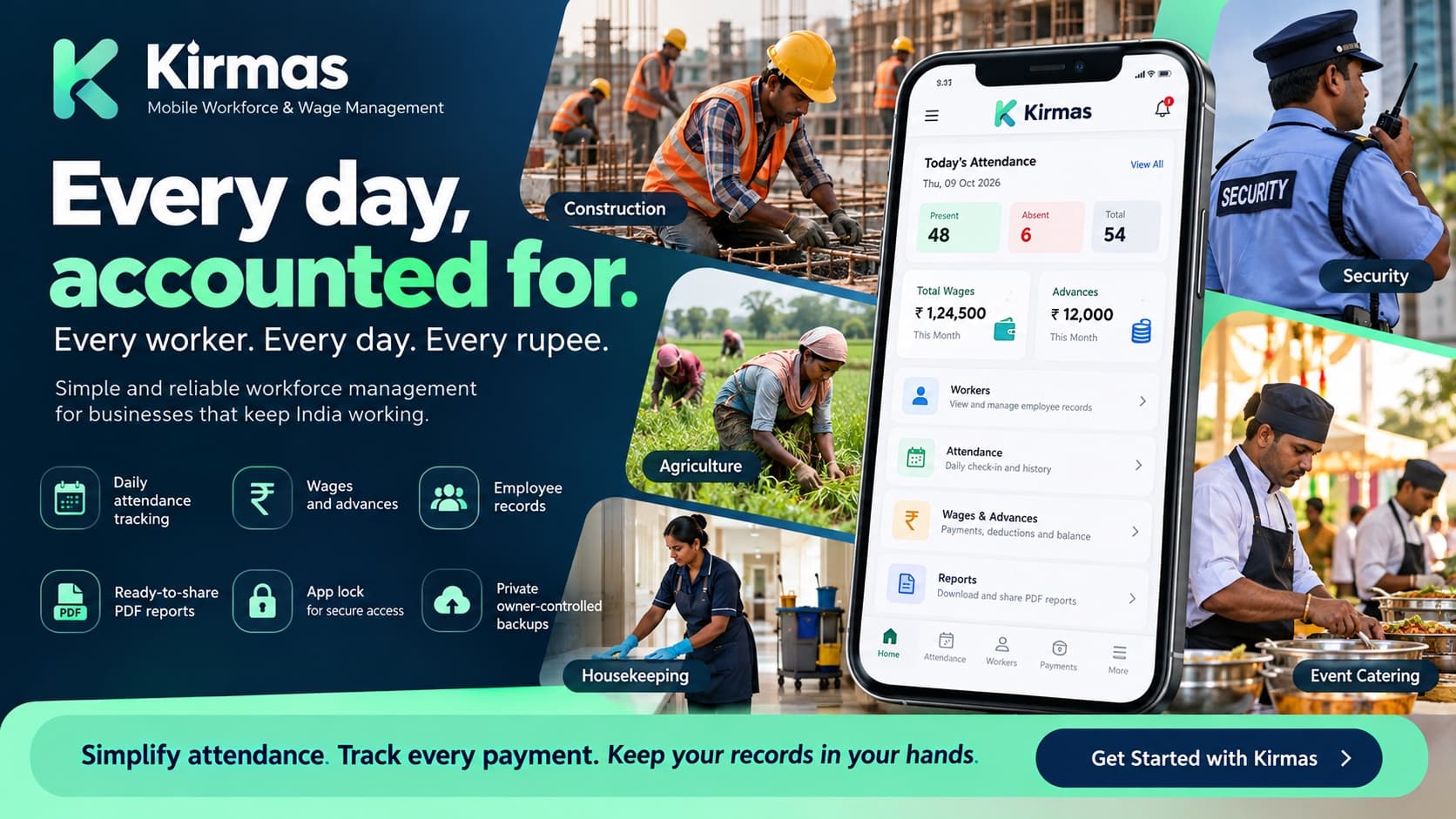
Kirmas workforce management promotional banner showing the mobile app alongside construction, agriculture, security, housekeeping and event catering teams
Our ProductWorkforce & Wage Management

Kirmas

Kirmas is a mobile workforce and wage management app for contractors and small businesses managing daily-wage and contract workers. Track attendance, manage wages and advances, maintain employee records, and generate PDF reports — all from your phone.

  • Daily attendance tracking: present, absent, half-day and leave
  • Wages and advances with receipt photos and live balances
  • Employee records with photos, phone numbers, roles and documents
  • Ready-to-share PDF reports for attendance and employee records
  • App lock with PIN or biometrics and private backup to the owner's Google Drive
  • Works offline for daily records, with internet needed for backups
  • Mobile App
  • Workforce Management
  • Wage Tracking
View Kirmas

Have something similar in mind? Start from the constraint and we will tell you what it would take to build.

Talk to our team
18 — CONTACT

Tell us what
you’re building.

Send the problem, the constraint, or the half-formed idea. We will tell you what it would take to build — and whether we are the right people to build it.

What to reach out about

  • Product development
  • Custom software
  • AI systems
  • Computer vision
  • Hardware / IoT
  • Data and automation
  • Technology engineering enquiry

We use the details you share only to reply to your enquiry. Your message is delivered by email through Web3Forms.